Getting Started with Private Roads
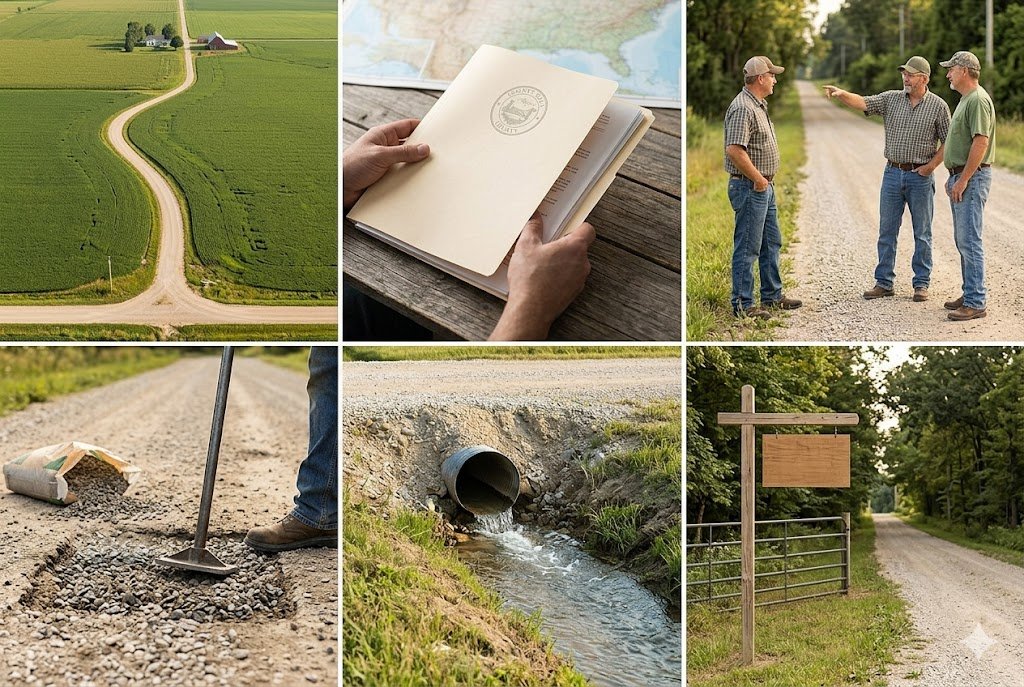
If you own or are purchasing property served by a private road, understanding your rights and obligations from the beginning can prevent costly disputes and unexpected expenses. This guide covers the fundamentals.
What Is a Private Road?
A private road is a road or driveway that is not owned or maintained by a government entity — it belongs to one or more private individuals. Unlike public roads, which are maintained by state or local governments using tax dollars, private roads are the responsibility of the property owners who use them.
Private roads are common in rural areas, subdivisions with shared access lanes, gated communities, and older developments that predate municipal road standards. They are also frequently found where multiple landlocked parcels must share a single access route to a public road.
What Is an Easement?
An easement is a legal right to use another person's land for a specific, limited purpose. A road easement gives you the right to travel across a portion of a neighbor's property to access your own. Easements can be:
- Express easements — written into a deed or recorded separately with the county
- Prescriptive easements — established by long-term open, continuous use (similar to adverse possession)
- Easements by necessity — granted by a court when a property is landlocked with no other access
- Implied easements — inferred from the circumstances of a property's history
The type of easement you have significantly affects your rights and obligations, especially around maintenance costs.
Who Is Responsible for Maintenance?
Maintenance responsibility depends on your state's laws, any recorded easement language, and any separate road maintenance agreements. As a general rule:
- If multiple properties share a road, all users typically share maintenance costs
- The easement holder (person with the right to use) often bears primary maintenance responsibility
- Some states have default rules that apply when no agreement exists
- Road maintenance associations formalize these obligations in writing
Check your deed, any recorded easement documents, and your state's statutes. See our state guides for state-specific rules.
Your First Five Steps
- Pull your deed and title report. Look for easement language, road maintenance agreements, or references to road associations. Your title company or county recorder's office can help.
- Search for recorded agreements. Road maintenance agreements are often recorded separately from deeds. Check with your county recorder or register of deeds.
- Identify all road users. Find out which properties share your road and who the current owners are. This is your stakeholder group for any future agreements.
- Assess current road condition. Walk or drive the full length of the road. Note drainage issues, surface deterioration, vegetation encroachment, and any safety concerns.
- Consult an attorney if needed. If easement language is unclear, if a neighbor is disputing obligations, or if you are purchasing property with a private road, a real estate attorney can clarify your rights before problems develop.
Common First-Year Mistakes to Avoid
- Assuming the county maintains your road because it has a name on a map
- Making major road repairs without first getting agreement from all users on cost-sharing
- Ignoring drainage issues — poor drainage is the number one cause of premature road failure
- Failing to document the road's condition with photos when you move in
- Not recording a road maintenance agreement with the county — unrecorded agreements don't bind future owners
🔧 Recommended Tool: 8"x8" Steel Tamper with 48" Handle — Heavy Duty Hand Compactor
Homeowners managing gravel or unpaved private roads find a basic road grading and compaction tool invaluable for seasonal maintenance. A steel hand tamper is one of the most practical tools for pothole repair, edge work, and compacting gravel fills without hiring a contractor for small jobs.
As an Amazon Associate, we earn from qualifying purchases. This does not affect the price you pay.